
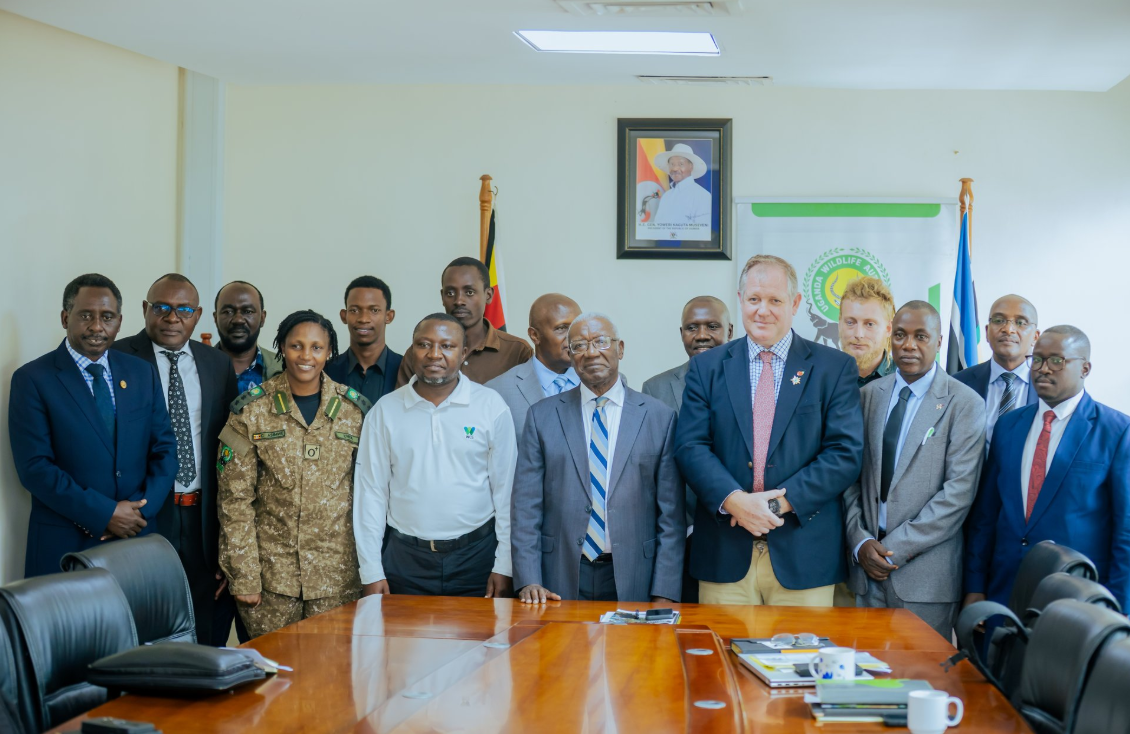
The Government of Uganda has stepped up efforts to protect and restore the country’s lion populations and other large carnivores with the launch of the National Lion/Large Carnivore Conservation Taskforce.
The Taskforce was launched today (November 10th 2026) by the Minister of Tourism, Wildlife and Antiquities, Hon. Col. Tom Butime, bringing together conservation experts, researchers, government institutions, universities and tourism industry representatives to provide strategic guidance on the protection and recovery of large carnivores in Uganda.
The initiative comes at a critical time when lions and other large carnivores face increasing threats, including habitat loss, retaliatory killings, poisoning, snaring, declining prey populations and illegal wildlife trade.
Speaking at the launch, Hon. Butime underscored the ecological and economic importance of protecting Uganda’s iconic wildlife, noting that lions are a significant attraction for international visitors and contribute to tourism revenues, employment and community livelihoods.
“Protection of lions and other iconic wildlife species should be prioritised because they attract tourists and immensely contribute to revenue generation, employment and livelihoods of our people,” he said.
The Taskforce will support the implementation of Uganda’s Strategic Action Plan for Large Carnivore Conservation (2024–2034), which seeks to increase viable large carnivore populations by 30 per cent over ten years and reduce poaching by at least 50 per cent.
The plan prioritises habitat protection and restoration, strengthening law enforcement, addressing human-wildlife conflict, community participation, research and wildlife population monitoring, with particular attention to conservation challenges in Kidepo Valley and Queen Elizabeth National Parks.
Mr. Michael Keigwin(MBE) Founder Trustee and Director of the Uganda Conservation Foundation, who will chair the Taskforce, emphasised the need for collective action and stronger institutional capacity to secure the future of Uganda’s large carnivores.
He noted that Uganda has considerable potential for wildlife recovery, given its rich biodiversity and historical wildlife populations, but acknowledged that significant conservation challenges must be confronted through practical and coordinated interventions.
He called for stronger support to the Uganda Wildlife Authority (UWA), particularly in specialised law enforcement, veterinary services, biodiversity management and habitat restoration. He further emphasised that conservation efforts must place neighbouring communities at the centre of interventions, describing them as indispensable partners in protecting wildlife.
“The Taskforce is not about individual organisations or individuals. We are now collective for a national purpose. Our responsibility is to support UWA and ensure that the next generation inherits the best possible conservation legacy,” he said.
The Chairperson also highlighted the connection between wildlife conservation and Uganda’s broader tourism ambitions, noting that restoring wildlife populations and improving the management of protected areas will be essential to growing tourism and unlocking the sector’s potential to generate employment and economic opportunities.
The establishment of the Taskforce builds on Uganda’s commitments under the African Carnivores Initiative and reinforces the Government’s commitment to collaborative, science-led and sustainable wildlife conservation.
Its membership includes Dr. Alex Braczkowski, Prof. Charles Masembe, Mr. Charles Tumwesigye, Dr. Simon Nampindo, Dr. Ludwig Siefert, Mr. Candia Leone, Prof. Moses Muhumuza and Mr. Benon Ssebina Katumba.
The Taskforce will review existing conservation interventions, identify emerging threats, recommend priority actions and support resource mobilisation for large carnivore recovery. UWA will serve as its Secretariat, coordinating follow-up on recommendations in collaboration with the Ministry and conservation partners.
Through this initiative, the Ministry of Tourism, Wildlife and Antiquities reaffirms its commitment to safeguarding Uganda’s natural heritage, strengthening protected area management and ensuring that wildlife conservation continues to underpin the country’s tourism growth and sustainable development.