
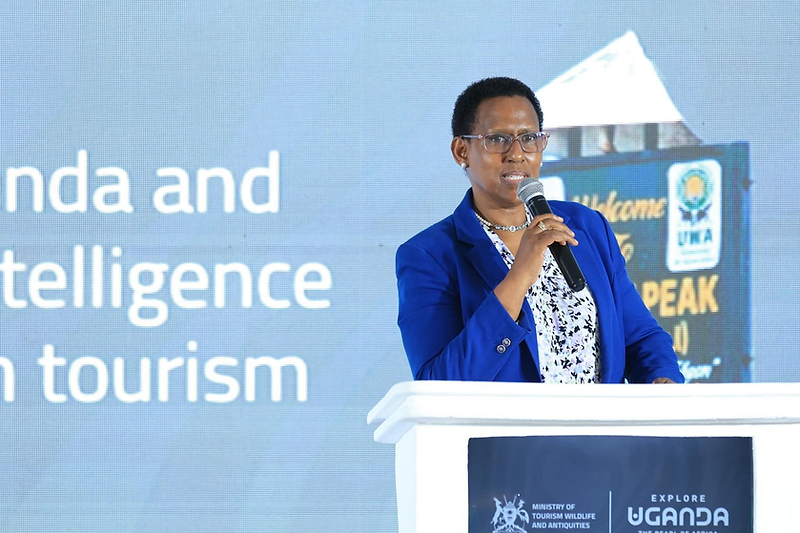
Doreen S. Katusiime, Permanent Secretary, Ministry of Tourism, Wildlife and Antiquities.
The Ministry of Tourism, Wildlife and Antiquities together with its agencies, including the Uganda Tourism Board (UTB), Uganda Wildlife Authority (UWA), Uganda Hotel and Tourism Training Institute, Crested Crane Hotel, Uganda Wildlife Research and Training Institute, and Uganda Wildlife Conservation Education Centre (UWEC), alongside key players from the tourism and hospitality private sector, development partners, and representatives from the creative industry on Thursday launched the 2026 World Tourism Day programme at Marriot Hotel Kampala, placing artificial intelligence, digital transformation and Eastern Uganda’s tourism economy at the centre of a month-long national campaign.
The Ministry revealed that the national World Tourism Day celebrations will be held on September 27 at Mbale Secondary School Grounds in Mbale City, bringing government, tourism businesses, conservation agencies, communities, creatives and development partners together to examine technology’s growing influence on the industry.
Held under the theme, “Digital Agenda and Artificial Intelligence to Redesign Tourism,” the celebrations come as Uganda seeks to turn recovering visitor numbers into higher tourism earnings, longer stays, stronger domestic travel and major economic opportunities for communities across the country.
The Ministry’s Permanent Secretary Doreen Katusiime revealed that His Excellency President Yoweri Kaguta Museveni is the Chief Guest during the day’s celebrations.
This year’s World Tourism Day celebrations will serve as a platform to accelerate investment, digital adoption, destination marketing, conservation and tourism-led local development.
“Tourism is changing rapidly,” Katusiime told tourism industry leaders and stakeholders at the launch. “The modern traveller now increasingly discovers destinations online. They compare experiences. They make their bookings online. They pay digitally. They read reviews and share experiences through social media and other digital platforms.”
That shift, she said, means Uganda’s visibility and competitiveness as a destination will increasingly depend on how effectively tourism businesses, government agencies and communities embrace digital technologies.
The ministry says artificial intelligence can strengthen destination marketing, personalise visitor experiences, improve customer engagement, analyse tourism data and help businesses make faster and better-informed decisions.
Katusiime noted, however, that Uganda’s digital transformation must not widen the gap between established tourism operators and smaller enterprises that lack the financial resources, knowledge or technology required to compete effectively online.
She called on businesses already benefiting from digital technology to mentor smaller operators, share knowledge and develop affordable solutions that can be adopted throughout the tourism value chain.
“Our digital transformation must be inclusive,” she said. “No tourism businesses should be left behind.”
An Encouraging but Mixed Performance Picture
The digital push is being launched against an encouraging but mixed tourism performance picture.
According to half-year tourism statistics presented by the ministry, Uganda received 739,815 international visitors between January and June 2026, representing a 3.7 percent increase compared with the corresponding period in 2025.
More significantly, tourism receipts increased by 25.6 percent to approximately Shs2.3 trillion, while the average visitor’s length of stay rose from 7.4 nights to 8.3 nights.
The figures suggest Uganda is extracting greater economic value from international tourism, even as the industry continues navigating disruptions and weaknesses in individual tourism segments.
Katusiime said the performance should encourage the sector while simultaneously forcing policymakers and businesses to confront a more important question on how Uganda can capture substantially more value from each person who visits.
That will require encouraging travellers to stay longer, visit multiple destinations, buy locally produced goods, experience Uganda’s food and culture, use local guides and entertainment services, and spend across a broader range of businesses.
Digital technology, she argued, offers a route to achieving that objective because it can make tourism products outside Uganda’s traditionally dominant wildlife offering more visible to prospective travellers.
Food, music, dance, heritage, coffee, adventure, cultural experiences and community tourism can increasingly be marketed alongside national parks and wildlife, broadening Uganda’s tourism proposition and spreading spending across more communities.
She said the country must sustain investment in conservation, destination marketing, product diversification and visitor experience if tourism is to remain resilient and internationally competitive.
Tourism Month Programme
World Tourism Day will therefore serve as the climax of a wider Tourism Month programme running throughout September, designed to mobilise Ugandans around domestic travel while creating stronger links among government, private businesses, conservation organisations, young people and host communities.
Activities to run through the tourism month of September will include Miss Tourism Uganda launch scheduled for 4th September, student engagement programmes, a tourism conference, a nationwide clean-up exercise planned for 26th September centred on Mbale, Recognition of Excellence Awards and an Explore Eastern Uganda domestic tourism campaign that will run from 28th – 30th September.
The decision to take the national celebrations to Mbale is deliberate as Eastern Uganda combines adventure, nature, culture, heritage and agricultural tourism, yet many attractions remain less visible than Uganda’s better-known wildlife destinations.
Mbale serves as an important gateway to attractions including Mount Elgon National Park, Sipi Falls, Wanale Hill, Sisiyi Falls, coffee tourism experiences and the cultural heritage of communities around the Mount Elgon region.
“The objective is not simply to showcase beautiful places,” Katusiime said, explaining that the campaign should stimulate actual visitation, generate business opportunities and connect communities to tourism spending.
Uganda Tourism Board Chief Executive Officer Juliana Kagwa said Eastern Uganda holds substantial potential for destination storytelling, recalling that Sipi Falls was among the first attractions she highlighted through digital content after taking up her role at UTB.
Her remarks reinforced one of the central messages emerging from the launch that Uganda possesses compelling tourism assets, but converting them into sustained visitor numbers increasingly depends on how effectively their stories are packaged and distributed.
Conservation at the Centre
The campaign will also place conservation at the centre of Tourism Month.
Dorcus Twesigomwe Rukundo, representing the Uganda Wildlife Authority Executive Director James Musinguzi, said tourism and conservation remain inseparable and announced the open park days an initiative giving Ugandans free access to selected protected across Uganda as the initiative is intended to encourage domestic travellers including Ugandans who have never entered a national park to experience the country’s wildlife and become ambassadors for conservation and tourism.
Selected destinations include Queen Elizabeth National Park, Murchison Falls National Park, Lake Mburo National Park and Kidepo Valley National Park, alongside wildlife reserves including Pian Upe, Toro-Semliki, Katonga and Ajai.
Dorcus added that some high-demand destinations with strict visitor limits including Bwindi Impenetrable Forest National Park and Mgahinga Gorilla National Park, plus Kibale Forest National Park where chimpanzee tracking is done are not be included because conservation rules restrict the number of visitors who can enter at a given time.
Rukundo also highlighted the newly established wildlife facility in Mbale as part of efforts to decentralise conservation education and bring wildlife experiences closer to communities. UWA also enlisted musicians and social-media influencers to visit protected areas and share their experiences with audiences that conventional tourism campaigns may struggle to reach.
Private Sector and Host City
The Uganda Tourism Association, representing private-sector operators, similarly supported the emphasis on digital transformation.
UTA Vice President Isa Kato said the internet and artificial intelligence now influence travellers long before they physically arrive at a destination. Search results, online reviews, social-media content, digital booking systems and destination information can determine whether a traveller chooses Uganda or a competing market. For private operators, that means technology is no longer an optional marketing addition but increasingly part of the infrastructure through which tourism is discovered, compared, purchased and reviewed.
Kato called for greater collaboration between the private sector, government and media in strengthening Uganda’s visibility internationally plus mobilise Ugandans to participate in Tourism Month.
Mbale City Mayor Joyce Kidulu Matuka, said preparations are underway to ensure the host city can accommodate national attention and increased visitor activity.
She said as City leaders, they have committed to beautification and cleanliness programmes as Mbale seeks to reclaim its historic reputation as one of Uganda’s cleanest urban centres.
She also revealed the celebrations will take place towards the last Saturday of the month when the national clean up exercise takes place as everyone will participate in cleaning the streets of Mbale ahead of the celebrations.
Source: Ministry of Tourism, Wildlife & Antiquities — original article on tourism.go.ug